Guide · General
10 Social Commerce Trends to Watch in 2026
The 10 social commerce trends shaping 2026, from livestream selling to AI feeds, with sourced adoption and purchasing data for every claim.
By the Statlyst data desk · Updated November 11, 2026 · 13 min read
How big is social commerce, and does the number anyone quotes survive contact with its definition? The answer decides whether the channel looks like a rounding error or a fifth of online retail, and the two readings lead to different budget decisions.
The scale isn't in dispute. UNCTAD reports that businesses in 46 developed and developing economies, together representing about three quarters of global GDP, recorded nearly $28 trillion in e-commerce sales in 2024, and that available market estimates place global social-commerce sales at roughly $700 billion in 2024, about 19% of worldwide e-commerce. A separate 2025 industry analysis sized the market at USD 924.47 billion, up 11.8% year over year after a 15.2% compound annual growth rate from 2021 to 2024, and projected roughly USD 1.48 trillion by 2030 on a 10.0% CAGR (ResearchAndMarkets social commerce report).
Both figures can be right at once. One counts purchases completed inside a social app; the other can include purchases that social content influenced. Every number in this list carries a named primary source, its data year and its exact scope, and nothing is estimated or rounded beyond what the publisher stated.
The ten social commerce trends below run from the most production-heavy formats to the most automated: livestream shopping, shoppable short-form video, native in-app checkout, creator-led affiliate commerce, social search, group buying, conversational commerce, user-generated content and reviews, small-seller commerce, and AI-ranked feeds.
Table of Contents
- 1. Livestream Shopping
- 2. Shoppable Short-Form Video
- 3. Native In-App Checkout
- 4. Creator-Led Affiliate Commerce
- 5. Social Search as a Product Discovery Channel
- 6. Group Buying and Community Commerce
- 7. Conversational Commerce in Messaging Apps
- 8. User-Generated Content and Reviews as Sales Assets
- 9. Social Commerce for Small Sellers and Resellers
- 10. Shopping Driven by AI Recommendations in Social Feeds
- 10 social commerce trends at a glance
- Choosing Which Trend to Act On
1. Livestream Shopping
Livestream shopping has become a very large and fast-growing part of China's e-commerce market, and the format it perfected is now being rebuilt at smaller scale in the United States.

A livestream compresses three jobs that normally happen on a landing page, in a review section and in a support inbox. The host demonstrates the product, answers objections in the comments and releases a time-limited price, and the viewer buys from a pinned product card without leaving the stream.
That structure explains both the economics and the workload. Sales concentrate inside the broadcast window, so the host's ability to hold attention and resolve doubts in real time replaces the funnel a product page would otherwise carry.
Practical rule: Judge a livestream by revenue per broadcast hour, not peak viewers. A stream with 400 committed buyers beats one with 40,000 passers-by and no orders.
- Fix the schedule: Run streams at the same times each week so regular viewers can plan around them.
- Prepare the product list and pricing in advance: Display product links clearly and in the order you intend to present them.
- Track conversion per stream: Decide which formats and categories justify the production cost before adding more slots.
Taobao Live, operated by Alibaba, established the format at scale in China, and Whatnot has adapted it in the United States as a livestream marketplace for collectibles and resale goods. Both run on the same mechanic: the broadcast is the storefront, and the host is the merchandiser.
2. Shoppable Short-Form Video
A tagged video earns less than its price tag suggests. As of July 15, 2025, TikTok Shop's listed commission was 5.45% for electronics sellers outside the Bonus Extra Program and 4.36% for participating sellers; for fashion and fast-moving consumer goods the rates were 7.085% and 5.995%. A separate 2.18% transaction fee applied as of September 2025, and the charges are deducted after successful delivery or fulfillment (SPS Commerce breakdown of TikTok Shop seller fees).
That arithmetic decides which products belong in a video at all. A low-margin accessory can go viral and still lose money on every unit once commission, transaction fee and returns are counted.

Shoppable short-form video places the product tag inside the clip, so one asset carries awareness and conversion. TikTok Shop lets sellers tag products in videos and livestreams, and Instagram Reels product tags do the same job for eligible brands. Reach by market is the input that decides whether any of it matters, and Statlyst's social media usage statistics set out platform reach and time spent market by market.
- Show the product in the first seconds: Viewers decide whether to keep watching long before the tag appears.
- Use one call to action and one product tag per clip: Two links split attention and depress clicks.
- Compare tag click-through against purchase data by format: A format that wins on clicks can still lose on returns.
3. Native In-App Checkout
Checkout is where social browsing becomes either revenue or a closed tab. In Deloitte Digital's 2025 State of Social Research, 71% of consumers rated their most recent purchase on a social media platform as good or excellent, while 34% said an easier payment process would make them more likely to purchase through these platforms. Satisfaction holds up; the exit still leaks.
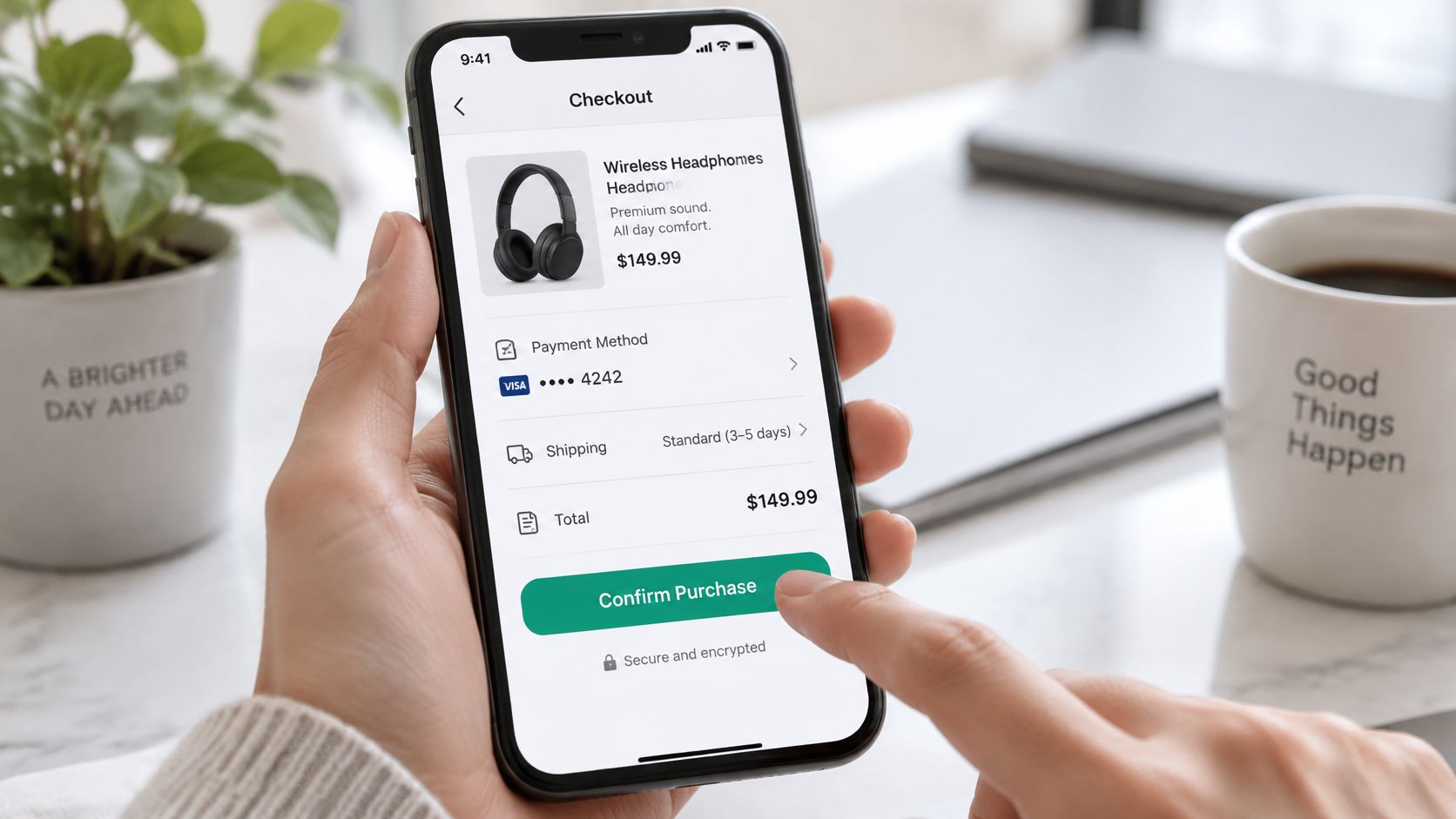
The convenience carries a cost that growth curves hide. PwC's retail monitor puts the European social-commerce market at €135 billion in 2025, forecasts growth of more than 15% annually through 2033, and warns that in-app checkout reduces retailers' access to first-party customer data, weakening personalization, retention and upselling.
Say a skincare brand sells a serum through a platform's native checkout. The order is logged, but the buyer's email address, repeat-purchase history and product preferences stay with the platform. The brand bought a sale and rented the relationship.
Operational check: Keep a first-party checkout running alongside the in-app one and compare repeat purchase rates between the two after 90 days.
- Confirm market and payment support first: Native checkout availability varies by country and payment method.
- Keep the product feed accurate: Stale prices or stock levels produce failed orders and refunds.
- Measure conversion by checkout type: Completion rates by device sit in Statlyst's mobile commerce statistics.
4. Creator-Led Affiliate Commerce
In April 2025, 76% of social-media users surveyed by Sprout Social said social media had influenced at least one purchase in the previous six months (Sprout Social Q2 2025 Pulse Survey, reported by SGi Europe). Influence isn't a transaction, which is exactly why affiliate structures matter: a tracked link or code turns a recommendation into a payment with a name attached to it.
Affiliate commerce pays independent creators a commission on sales they generate. The creator picks what to recommend, the brand gets a sale it can trace to a specific post, and both sides can see which content earned its keep. Smaller creators get a route to income that doesn't depend on brand deal volume.
Say a small coffee roaster offers five home-brew creators a code each. After a month, the report shows two creators drove most of the revenue and one drove none. Next month's budget follows the revenue, not the follower counts.
- Require visible disclosure: Every paid post needs a plain statement of the relationship.
- Write commission terms and tracking windows before launch: Attribution disputes are the usual failure point.
- Rank partners by revenue per creator: Follower count predicts reach, not sales.
Platforms such as LTK, a creator storefront and affiliate platform focused on fashion and home goods, and the Amazon Influencer Program, which pays commission on referred purchases, have made this a standard channel rather than a novelty.
5. Social Search as a Product Discovery Channel
53% of shoppers globally discovered products through social platforms in 2025, up from 46% in 2023, according to Salesforce's Connected Shoppers Report. The shift moves the start of the buying journey out of a general search engine and into an app where the review, the video and the buy button share one screen.
What changes is the query itself. People type "best serum for dry skin" into a video app instead of a search box, and what comes back is video rather than links. Content that never names the product category in words is invisible to that behavior.
- Write the product into the caption and title: "Ceramic pour-over cone, 2-cup" gets found; a clever caption doesn't.
- Fill in product attributes properly: Category, size and material are matchable fields, not decoration.
- Watch the platform's search suggestions: Recommended queries reveal demand you haven't built content for.
Pinterest Lens handles the visual version, identifying products from a photo, and TikTok search returns product videos and creator reviews for the same intent. Both reward structured descriptions over brand slogans, which is a change in discipline for teams trained on campaign copy.
6. Group Buying and Community Commerce
Group buying sells a discount through a network rather than an ad. A buyer invites others, the price falls when enough people join, and the sharing itself does the distribution work that paid media would otherwise have to buy. The format fits markets where price sensitivity is high and messaging apps are the default social layer.
Pinduoduo built this model at national scale in China, and Meesho applies a related structure in India by enabling small resellers to sell to their own networks. The common thread is that the seller is usually a customer too, which changes the economics of acquisition.
Say a neighborhood group orders fruit in cases of twelve. The organizer posts the offer, collects twelve commitments and takes a small margin or a free case. The supplier gets a predictable bulk order and spends nothing on acquisition.
- Publish the minimum group size and deadline: Ambiguous terms stall sharing at the first step.
- Test price tiers on a small product set: Margin damage is hard to reverse once a price is public.
- Track repeat purchases after the group closes: Group buyers often don't return without a fresh incentive.
7. Conversational Commerce in Messaging Apps
Messaging turns a product question into an order without a website visit. The customer asks whether a jacket runs small, gets an answer, pays in the thread and tracks delivery in the same place. Statlyst's AI chatbot statistics cover the automation layer behind that exchange.
WhatsApp Business does this with catalogs, business profiles and automated messages built for small and mid-sized sellers, and Facebook Messenger supports comparable order handling in chat. The advantage isn't novelty. Messaging is already a daily habit, so the customer doesn't have to learn an interface in order to buy.
Consent is the whole game. One unsolicited promotional message can end a thread that took a year to build, so the opt-in record matters more than the template design.
- Record opt-in before promotional sends: Keep the date, source and wording of the consent.
- Give a visible route to a human agent: Complex questions stall when a bot loops.
- Review message volume and response times monthly: Response time drives cost and satisfaction together.
8. User-Generated Content and Reviews as Sales Assets
Seller adoption is running ahead of buyer adoption. DHL's global social commerce survey found that 63% of retailers sell through social platforms, but only 45% of shoppers buy there, and that 42% of shoppers are influenced by user-generated content and customer reviews.
That gap is a trust gap, not a reach gap. Sellers have listed products; buyers still want reassurance about quality, authenticity, returns, delivery and who is accountable when something goes wrong. Reviews and customer photos answer those questions in a way that brand-written copy can't.
Glossier built its product marketing around customer posts and reviews rather than studio photography, and branded hashtags on Instagram remain the cheapest way to collect customer photos for product pages. The material is free; the permission isn't optional.
- Get written permission before reusing a customer photo or video: A public post isn't a licence.
- Answer negative reviews in public and fix the cause: Prospective buyers read the response as closely as the complaint.
- Follow the rules on incentivised and fake reviews: Platform policy and national consumer law both apply.
9. Social Commerce for Small Sellers and Resellers
Social commerce cut the entry cost of retail down to a phone and a contact list. A reseller shares a listing with their network, collects orders through messages, and earns a margin or commission without holding inventory or running a storefront. Platforms carry the catalog, payment and logistics; the reseller carries the relationship.
Meesho lets small resellers in India sell to their own social networks, and Shopee's social selling programs give individual sellers live and video tools across Southeast Asia. The model brings first-time sellers into online retail, which is why it keeps expanding in price-sensitive markets.
The economics decide whether it lasts. Fees, return rules and payout timing differ enough between platforms that the same item at the same price can be profitable on one and loss-making on another.
- Compare fees, return rules and payout timing before choosing a platform: Payout lag is a working-capital cost.
- Buy small batches before committing to inventory: Trend items age quickly and returns erode thin margins.
- Keep customer records where platform rules allow: A following on one app isn't a customer list you own.
10. Shopping Driven by AI Recommendations in Social Feeds
Recommendation systems now decide which products get seen, and they rank on signals a merchandiser can't charm. Viewing history, watch time, engagement and the behavior of similar users determine whose feed a product lands in. Manual curation sets the catalog; the ranking system sets the audience.
TikTok's For You feed is the clearest case, ranking video and product content per user, and Pinterest applies visual interest signals to suggest products from images. In both, a product that isn't described and categorized properly is hard for the system to place against the right viewer.
Say an outdoor brand lists a rain shell without a category, a size range or a material field. The ranking system has nothing to match against a user who watches hiking content, so the shell stays unseen while a worse-described competitor sells.
- Complete and categorize the catalog: Ranking quality depends on structured attributes, not ad budget.
- Read audience breakdowns for each product: The system will tell you who responded.
- Check market privacy rules before using customer data for targeting: Consent requirements differ by country.
10 social commerce trends at a glance
| Trend | Maturity | Best for | Main limitation |
|---|---|---|---|
| Livestream Shopping | Established in parts of Asia; growing elsewhere | Product demonstrations and real-time buyer questions | Requires skilled hosts and consistent production |
| Shoppable Short-Form Video | Growing | Turning creator or brand videos into direct sales | Platform rules and attribution can change or be difficult to track |
| Native In-App Checkout | Established but availability varies | Reducing checkout friction on social platforms | Merchant access to customer data may be limited |
| Creator-Led Affiliate Commerce | Established | Paying creators for trackable sales | Disclosure requirements and creator reputation risks |
| Social Search as a Product Discovery Channel | Emerging and growing | Reaching shoppers searching for product ideas and reviews | Results and review authenticity can be difficult to assess |
| Group Buying and Community Commerce | Established in some markets | Price-sensitive shoppers and referral-led sales | Thin margins and reliance on referral loops |
| Conversational Commerce in Messaging Apps | Established and expanding | Handling product questions, orders, and support in chat | Consent rules and automation quality can constrain service |
| User-Generated Content and Reviews as Sales Assets | Established | Building trust with customer-created product evidence | Requires permission and careful review management |
| Social Commerce for Small Sellers and Resellers | Established in some markets | Low-cost selling through personal networks | Margins, supplier reliability, and platform policies |
| Shopping Driven by AI Recommendations in Social Feeds | Growing | Personalized product discovery at scale | Opaque recommendations and privacy concerns |
Choosing Which Trend to Act On
Rank the ten by how directly attention becomes a tracked, attributable sale, and the order looks different from the order above.
Native in-app checkout sits first because it removes the largest drop-off in the funnel, with the caveat that the retailer surrenders first-party data on every order it processes. Creator-led affiliate commerce comes second: a tracked code ties revenue to a named partner, so nothing is inferred. Shoppable short-form video third, because the tag rides inside the content and the click is measurable. Livestream shopping fourth, since it converts in real time but demands production hours per session.
Then the intent-capture group. Social search fifth, because it intercepts demand that already exists rather than creating it. Conversational commerce sixth, which closes in a thread but scales poorly without automation. Group buying seventh, which recruits committed buyers by design but usually on thin margin.
The last three work indirectly. User-generated content and reviews reduce doubt before checkout without producing a sale on their own. Small-seller commerce is a distribution model rather than a brand channel. AI recommendation determines who sees a product at all, which makes it the furthest from the transaction and the hardest to attribute.
A three-step plan follows from that order.
- Pick one channel that matches the product category. A collectible with a resale market suits livestream selling. A commodity accessory with thin margin does not.
- Verify supported markets and payment methods before committing. Platform checkout, tag availability and fee schedules change by country and by date.
- Measure conversion per channel from the first week. Sessions, orders, repeat rate and payout, recorded by channel, so the second month's budget rests on evidence.
The underlying figures matter more than the ranking. Statlyst maintains an Online Shopping Statistics 2026 page covering the size and growth of e-commerce in the United States, the United Kingdom, the EU, China and Australia, along with who buys online, holiday shopping, returns, delivery and checkout friction. It lists 54 figures from 14 primary publishers, updated November 4, 2026, with every figure linked to its source and free CSV downloads, so any number in this article can be checked against its exact wording before it goes into a report, a pitch or a story.
Questions or corrections: editorial@statlyst.com